
Less chasing, more program
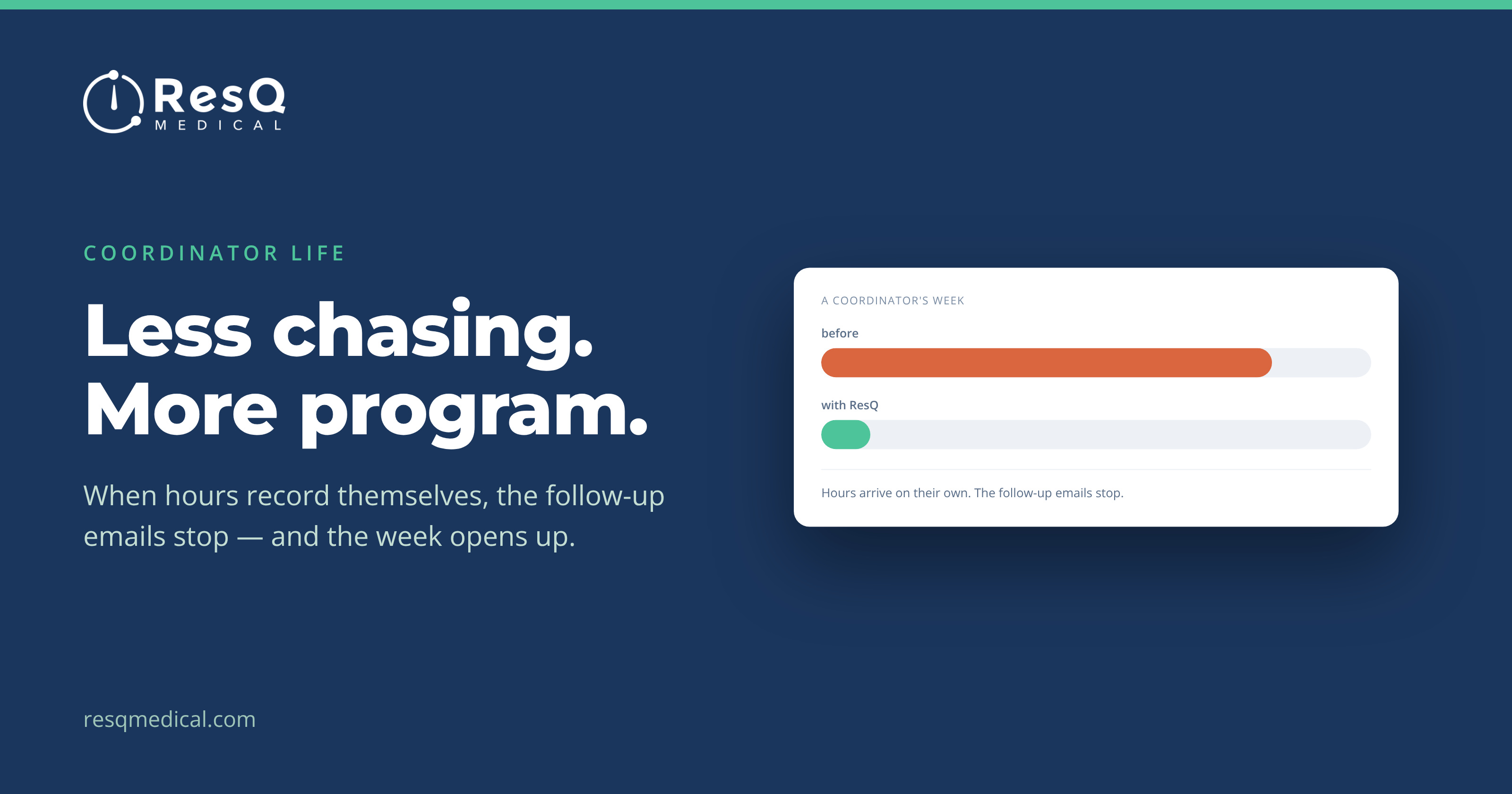
Ask a program coordinator where the week goes and you’ll hear some version of the same loop: remind residents to log, collect what’s missing, reconcile what doesn’t add up, repeat. Then a second loop on top of it: send the announcement, re-send the announcement to the people who missed it, field the three replies asking what the announcement said.
None of it is unimportant. All of it is a tax on the work only a coordinator can actually do.
The first loop mostly disappears
When hours record themselves at every WorkZone™, there’s nothing to remind anyone about. The record builds itself as residents move through their sites, so the reminding-collecting-reconciling cycle doesn’t get more efficient — it largely stops existing.
The knock-on effect shows up in reporting. Because there are no submissions to gather first, pulling numbers stops being an assembly job: choose the programs, set a date range, run the report, export it. No stitching spreadsheets, no footnote about who hadn’t logged yet.
The second loop gets a real channel
Reaching everyone is its own quiet time sink — a mailing list that’s never quite current, a group text somebody left, an email blast half the program skims past.
ResQ Broadcast puts the message on every resident’s phone in one tap, inside the app they already have. Room changes, deadlines, conference reminders, the schedule being posted. Then the part that saves the most time: read receipts, resident by resident — Read, Push sent, or Not sent — so following up is targeted at the four people who haven’t seen it instead of being a mass re-send to sixty.
The messages you send every week have templates, so the recurring ones are a click and a tweak. It’s deliberately narrow — one-way, text-only, 500 characters, with a standing reminder to keep patient information out.
What you get back
Time, mostly — and attention, which is scarcer. The hours that used to go into chasing and re-sending go back into onboarding a new class, untangling a schedule, and the residents who need a hand this week.
That’s the whole ambition here. Not a cleverer way to manage the administrative loop, but less of it to manage.
The same Tuesday, twice
Before: you open the week knowing four residents still haven’t logged, so you send the reminder, then the second reminder, then you rebuild two weeks by hand for the one who’s rotating off. Somewhere in there the schedule change goes out by email and three people miss it.
After: the hours are already there, so there’s no reminder to send and nothing to rebuild. The schedule change goes out as a Broadcast, and by lunchtime you can see fifty-six of sixty have read it — so you catch the other four in person rather than re-sending to everyone.
Same Tuesday. The difference isn’t that the work got faster; it’s that most of it stopped being work you had to do.