
WorkTime™ Awareness: see risk before it happens
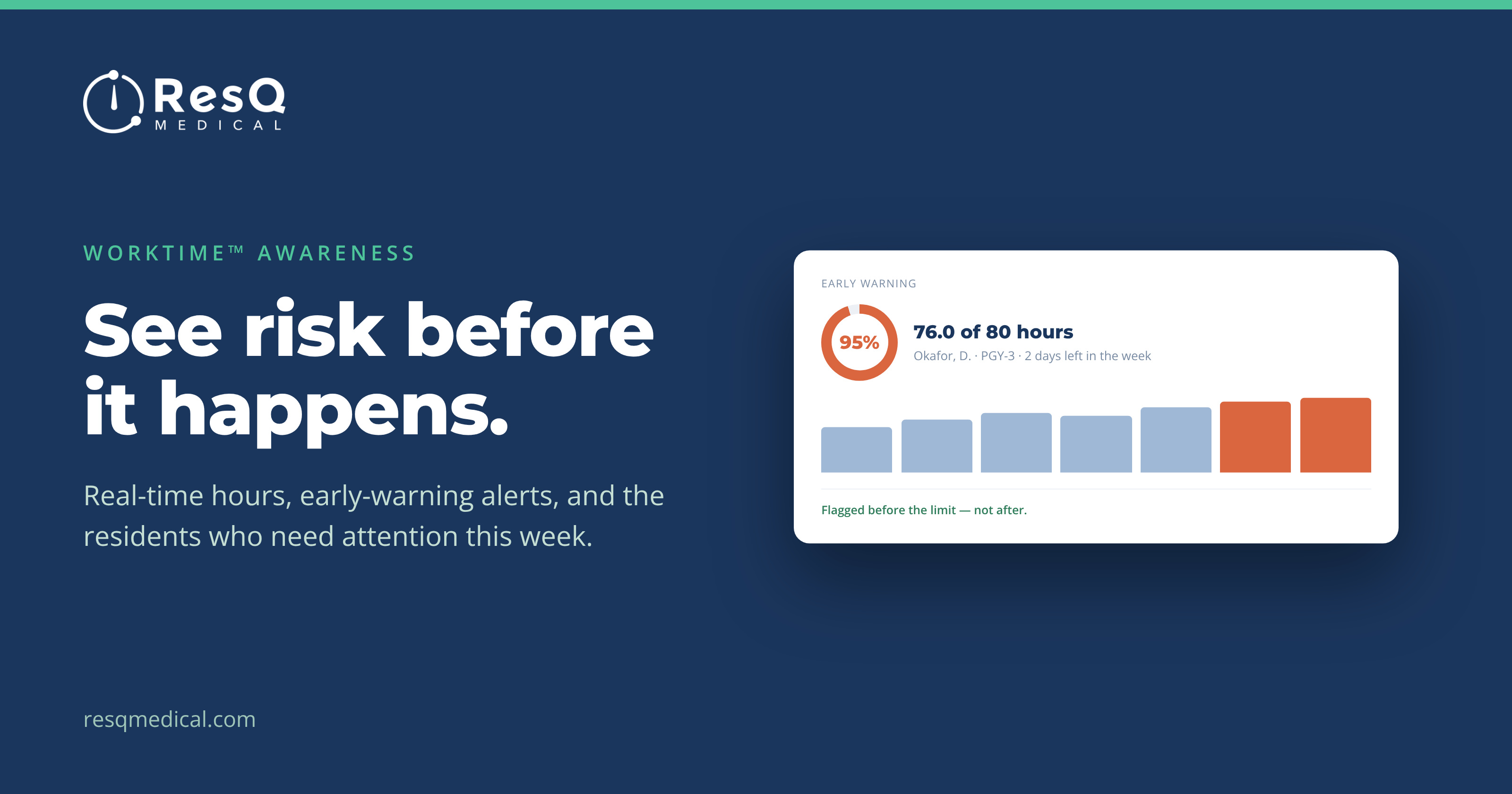
A monthly review flags a resident over the 80-hour average. Everyone reads the number, nods, and moves on — because the month is over. The schedule that caused it already ran. The resident already worked it. The only thing left to do is document it.
That’s not a reporting failure. A report answers a question you already have. What a program also needs is something that raises a question you don’t — early enough to matter. That’s WorkTime™ Awareness.
Risk hides inside the average
The 80-hour limit is averaged over four weeks, which is precisely what makes it sneaky. A resident can be heading toward a breach for three straight weeks without any single total looking alarming. By the time the average tips, the runway to fix it is gone.
So ResQ watches the trend rather than the verdict. When a resident reaches 95% of the 80-hour limit on their rolling four-week average, an alert goes by email to the program administrator — naming the resident and the program. They’re approaching a violation, not past one, and there’s still a schedule to change. Nobody has to be logged in to catch it.
The same early-warning logic covers 24+4 continuous duty and day-off thresholds.
What’s on the dashboard
Alerts push; the dashboard is there when you go looking. Without running a report you get:
- Active users, hours and violations at a glance, filterable by program
- Longest Active Shifts — what’s running right now, as it builds
- Longest Average Weekly Hours — who’s carrying the heaviest load
- Most Active WorkZones™ — where the hours are actually going
A GME office sees every program with the ability to drop into any single one. Program Directors and Coordinators see their own. Same recorded hours, scoped to the role — program-level access never extends to other programs.
Nothing to collect first
Every figure here comes from hours WorkTime™ Automation already recorded. There are no submissions to gather before the dashboard is trustworthy and no data entry to police — which is what makes “real-time” real rather than aspirational.
The goal isn’t a better record of what went wrong. It’s a schedule change instead of a citation.
Two different jobs, two different moments
It’s tempting to treat this as “reporting, but faster.” It isn’t. A report answers a question you already have — the quarter, the audit, the thing leadership asked for. Early warning raises a question you don’t have yet, at the only moment the answer is still useful.
Programs need both, and they fail in different ways. A program with only reports learns accurately and late. A program with only alerts reacts constantly without seeing the pattern. Awareness covers the first job; WorkTime™ Analytics covers the second, from the same recorded hours.
Which is why the honest framing of Awareness isn’t “catch more violations.” It’s “have fewer of them to catch,” because somebody saw the week coming and moved a shift.