
The Weekly Summary: your program’s week, delivered
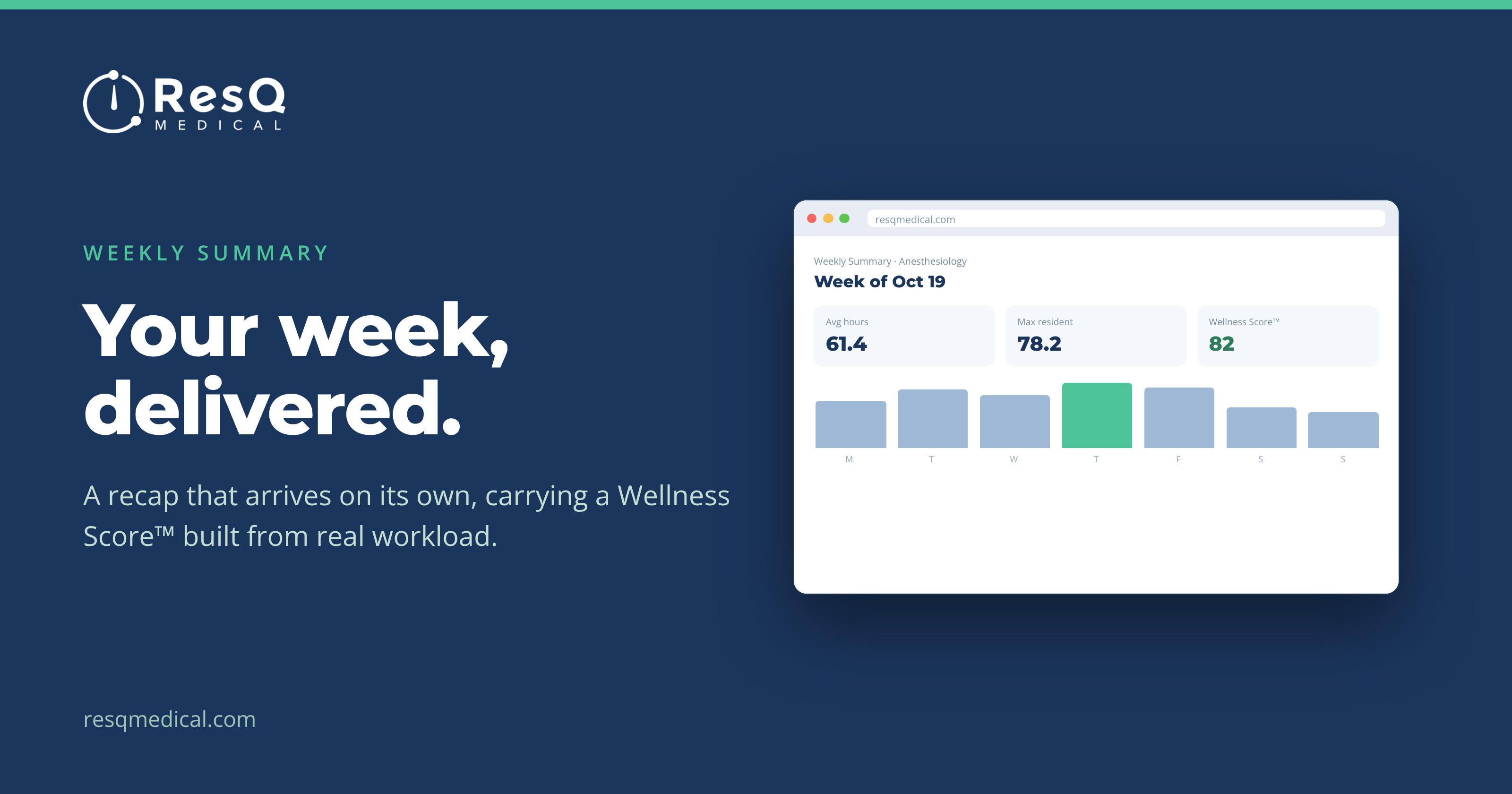
Most weeks don’t need a deep dive. Most weeks you want one question answered — is the program okay? — and then you want to get back to the forty other things.
The trouble with dashboards and reports is that both require you to remember to go look. On a normal week, nobody does. The Weekly Summary solves that by arriving on its own.
Delivered, not fetched
Nobody has to log in to find out where things stand. Each week:
- Residents receive their hours for the week, their four-week average, and a compliance checklist — so they know where they stand without asking anyone.
- Administrators receive the equivalent for the programs they manage.
It lands in the right inboxes without anyone running anything. That’s the entire point: keeping a read on your program shouldn’t depend on a habit.
A workload signal, not just a compliance answer
Every summary carries a Wellness Score™ — a signal built from real recorded workload rather than a survey. It matters because staying inside the rules and having a sustainable rotation are not the same thing. A program can be technically compliant and still be grinding people down.
Week over week, the score shows the pattern underneath the compliance answer: workload trends across a program over time, comparisons between programs at the institution level, and context for the harder conversation about how a rotation is designed. Strain shows up as a number before it shows up in people.
When something in the score warrants a closer look, the Trainee Wellness Summary report gives you a score for every resident across a date range, color-coded so the ones worth a conversation stand out.
Where it sits
Think of the three layers by the moment each one serves. The live dashboard is for now — what’s running, what’s building. The reports are for the review — the quarter, the audit, the question from leadership. The Weekly Summary is the steady heartbeat in between: a recurring, low-effort read that keeps a program from drifting for a month unnoticed.
What it catches that a monthly look doesn’t
Consider a rotation that gets quietly heavier three weeks running. No single week is alarming. Nobody files a complaint — residents rarely do, and certainly not in week two. On a monthly review cadence, the first anyone hears of it is after the block has ended.
A weekly signal changes that arithmetic. Three summaries in a row showing hours climbing and a Wellness Score™ drifting is a pattern a program director notices in week three, not week six — and week three is still early enough to move a call night or rebalance a service.
The value isn’t in any one email. It’s that twelve of them a quarter make a trend impossible to miss by accident.